Enterprise AI Memory Systems

Enterprise AI Context & Memory System Development

Build AI agents that remember how your business works. Most enterprise AI pilots fail because the model lacks structured business context — not capability. We design and build the memory layer that turns isolated AI tools into closed-loop business agents.

A chatbot can answer a question. A copilot can draft a document. But a production business agent needs more than a prompt — it needs memory. Access to the right company knowledge, past decisions, customer history, workflows, permissions, policies, feedback, and outcomes.

Language models are natively stateless: they only know what is placed into the current context window. Each new session starts from zero unless external memory infrastructure is added. For business workflows, that limitation is expensive — agents repeat work, lose goals, hallucinate, or force employees to constantly re-explain the business.

Implement Agentic builds the missing layer: a secure, governed, evaluated, business-specific memory and context system for AI agents. Based in Irvine, California, we serve mid-market and enterprise organizations across Orange County and beyond.

Build your enterprise AI memory layer

If your AI pilots are failing because agents lack context, forget prior work, or cannot be trusted in production — we can help.

Book an Assessment

What is an enterprise AI context & memory system?

An enterprise AI context and memory system is the infrastructure that decides what an AI agent should know, remember, retrieve, and use when completing business work. It combines context engineering, retrieval systems, short-term and long-term memory, knowledge graphs, evaluation loops, and governance controls.

Context engineering is the discipline of managing the finite set of tokens available to the model and optimizing what context is most likely to produce the desired behavior. In production, this moves teams beyond "prompt engineering" into designing the complete state available to the model at each step.

Memory types we design & build

Working & Short-Term Memory

Active task goals, current user intent, tool results, intermediate reasoning, approvals, and workflow stage — preserved within a session.

Long-Term Memory

User preferences, account history, prior decisions, successful proposal language, recurring risks, and department-specific operating procedures.

Episodic Memory

What happened in a specific event — discovery calls, sprint retros, legal reviews — with full temporal context.

Semantic Memory

Generalized business knowledge: industry requirements, SOW standards, integration patterns learned from repeated work.

Procedural Memory

How work should be done — qualifying pilots, drafting roadmaps, performing risk reviews, escalating low-confidence outputs.

Knowledge Graphs

Relationship reasoning across customers, projects, contracts, teams, policies, and systems — beyond text similarity.

Reference architecture

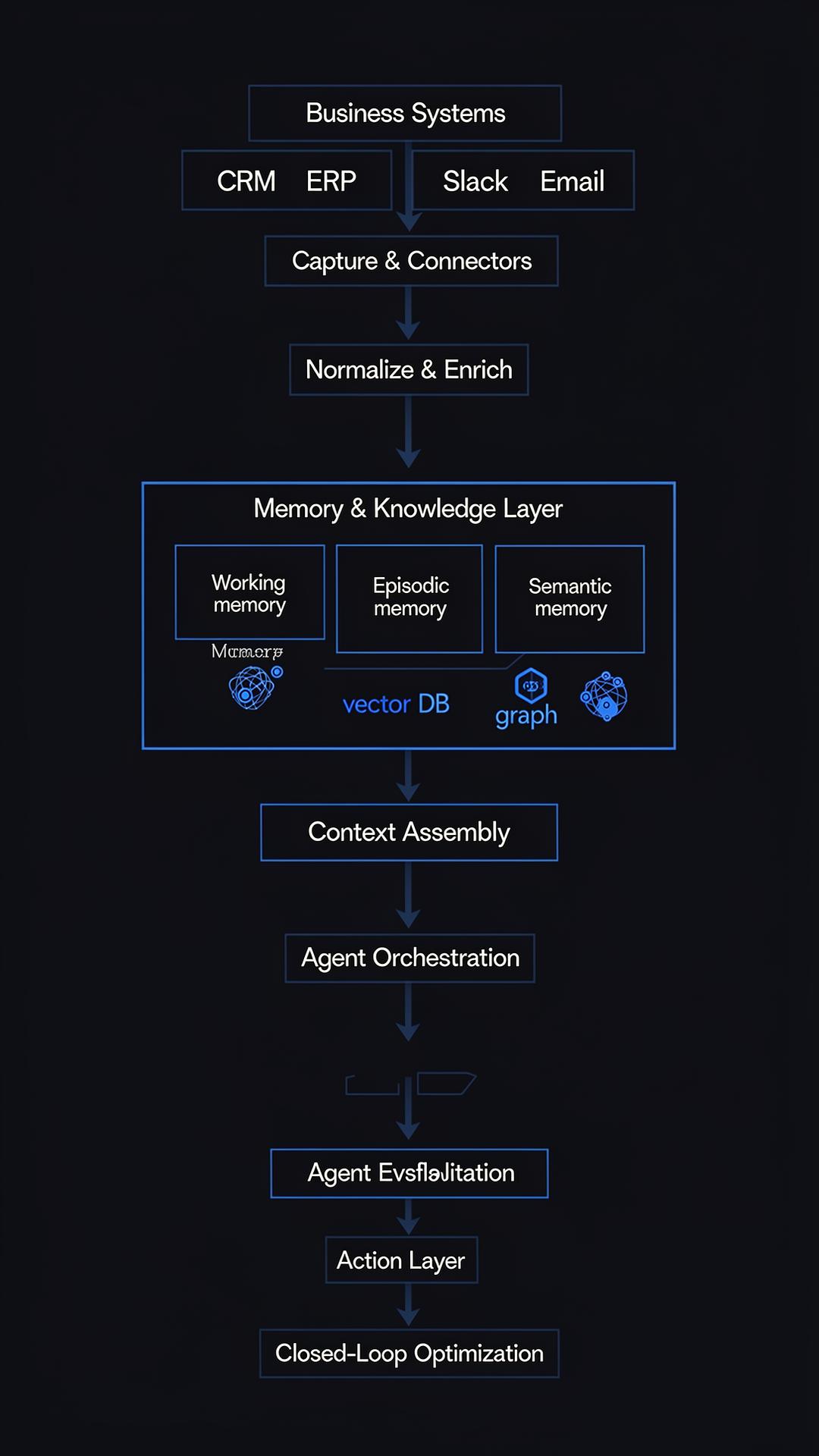
A production enterprise AI context and memory system follows this pattern — the memory layer sits between capture/normalization and reasoning/action, while evaluation continuously feeds back into memory and reasoning.

Enterprise AI context and memory system architecture diagram showing flow from business systems through capture, normalization, memory layer, context assembly, agent orchestration, action, evaluation, and closed-loop optimization

Common failure modes

Problems we see in enterprise AI deployments — and how we fix them.

Treating the context window as memory

Symptom: Users repeat themselves; agents forget prior constraints; long workflows lose coherence.

Fix: Design external memory stores with explicit write, retrieve, update, and delete policies.

Dumping too much into the prompt

Symptom: Verbose/inconsistent answers; important facts missed; costs rise; agent behavior degrades.

Fix: Retrieve narrowly, summarize intelligently, rank information, and compact old tool results.

Naive vector search

Symptom: Retrieved chunks sound related but don't answer the question; old policies retrieved instead of current.

Fix: Hybrid retrieval: keyword search, vector search, metadata filters, reranking, and freshness ranking.

No permission propagation

Symptom: Cross-customer leakage; confidential data exposed; agents summarize restricted meetings.

Fix: ACL-aware ingestion, retrieval-time filtering, tenant isolation, and audit logs.

Memory pollution

Symptom: Outdated preferences persist; temporary assumptions become permanent facts; incorrect outputs reused.

Fix: Separate draft from approved memory. Require confidence scoring, human approval, retention rules, and decay.

No evaluation set

Symptom: Retrieval changes made by intuition; regressions go unnoticed; demos work but production fails.

Fix: Build a golden eval set with representative tasks, expected context, expected answers, and failure categories.

No business outcome feedback

Symptom: Proposal agents don't learn from won/lost deals; workflows never improve beyond the pilot.

Fix: Connect memory updates to real outcomes: deal status, SLA performance, user edits, approval events.

Tool sprawl

Symptom: Wrong tool calls; repeated API calls; excessive latency; brittle orchestration.

Fix: Curate tools per agent role. Define schemas, permissions, retry policies, and human approval checkpoints.

How we evaluate AI context & memory systems

A memory system should be evaluated like a production system, not a prompt experiment.

Retrieval Quality

Recall@k, precision@k, MRR, context relevance, citation accuracy, freshness accuracy, permission-filter accuracy

Memory Write Quality

Usefulness, specificity, correctness, sensitivity classification, duplication rate, retention appropriateness

Context Assembly

Token efficiency, missing context, irrelevant ratio, source diversity, prompt budget usage

Agent Task Evaluation

Task success rate, human edit distance, approval rate, escalation rate, latency, cost per task

Governance & Safety

Unauthorized access detection, cross-tenant leakage, prompt injection resistance, PII handling

Closed-Loop Evaluation

Rejected language non-reappearance, preference persistence, outcome-driven improvement, policy freshness

Not sure whether you need RAG, long context, fine-tuning, or agent memory?

We'll map your workflows, data sources, risks, and business goals into a practical implementation roadmap.

Request a Context Readiness Review

How we implement enterprise AI memory systems

Phase 1

Context & Memory Assessment

Map workflows, data sources, permissions, and governance. Deliver context architecture map and pilot recommendation.

Phase 2

Memory Architecture Design

Design memory taxonomy, data model, retrieval strategy, security model, and evaluation plan.

Phase 3

Prototype & Eval Baseline

Build a working prototype, create golden test set, run baseline evaluations, identify failure modes.

Phase 4

Production Pilot

Connect approved systems, implement permissions, deploy observability, train users, collect feedback.

Phase 5

Optimization & Scale

Tune retrieval, expand workflows, improve latency/cost, build reusable agent patterns.

Service packages

Enterprise AI Context & Memory Assessment

2–4 weeks

$10K–$25K

Organizations with AI pilots that don't know why they're failing.

  • Workflow & data-source review
  • Context readiness assessment
  • Memory architecture recommendation
  • Risk & governance review
  • Prioritized use-case roadmap
  • Pilot proposal
Get started

AI Memory System Prototype

4–6 weeks

$30K–$75K

Organizations that want a working prototype around one high-value workflow.

  • Limited data ingestion
  • RAG pipeline
  • Memory schema
  • Agent workflow prototype
  • Human-in-the-loop review
  • Evaluation baseline & implementation plan
Get started
Most popular

Production Context Layer Pilot

8–12 weeks

$75K–$200K

Organizations ready to deploy an AI agent into a controlled business workflow.

  • Production-grade ingestion
  • Permissions-aware retrieval
  • Short-term & long-term memory
  • Agent orchestration
  • Observability & eval dashboard
  • Security controls & 30-day optimization
Get started

AI Memory Operations Retainer

Ongoing

$10K–$40K/mo

Organizations that need continuing improvement and governance.

  • Monthly eval review
  • Memory quality monitoring
  • Retrieval tuning
  • Prompt & context optimization
  • New workflow expansion
  • Governance support & stakeholder reporting
Get started

Enterprise use cases

Sales & Account Memory

Agents remember account history, objections, buying committee details, past deal outcomes, and customer preferences.

  • Call summaries
  • Proposal drafts
  • Objection handling
  • CRM updates
  • Renewal risk analysis

Project Delivery Memory

Agents remember requirements, architecture decisions, risks, dependencies, and change requests.

  • Status reports
  • Sprint plans
  • Risk summaries
  • Customer updates
  • Postmortems

Legal & Contract Memory

Agents retrieve clause libraries, negotiation history, approval rules, and customer-specific contract preferences.

  • SOW drafts
  • Clause recommendations
  • Redline summaries
  • Approval routing

Customer Support Memory

Agents remember prior tickets, customer preferences, product issues, escalations, and resolution paths.

  • Support drafts
  • Root-cause analysis
  • Knowledge-base updates
  • Customer health signals

Enterprise Knowledge Assistant

Agents retrieve governed company knowledge across documents, policies, meetings, tickets, CRM, and operational systems.

  • Grounded answers
  • Cited summaries
  • Expert finding
  • Onboarding guidance

Related services

Frequently asked questions

What is an enterprise AI memory system?+

An enterprise AI memory system is the infrastructure that lets AI agents preserve, retrieve, and apply business context across tasks and sessions. It can include RAG, vector databases, knowledge graphs, structured summaries, workflow state, user preferences, customer history, and evaluation feedback.

How is AI memory different from a context window?+

A context window is temporary — the information the model sees during a single call or session. AI memory is persistent infrastructure that stores and retrieves useful information across sessions, workflows, users, customers, and business processes.

How is this different from RAG?+

RAG retrieves relevant information from external sources and injects it into the model prompt. AI memory is broader. It includes RAG, but also stores session history, prior decisions, user preferences, workflow state, corrections, and business outcomes.

Do we need a vector database?+

Often, yes, but not always. Vector databases are useful for semantic retrieval over unstructured text, but many enterprise memory systems also need keyword search, metadata filtering, relational databases, graph databases, and structured summaries.

Is long context enough?+

No. Long context can help with synthesis over a known set of documents, but it does not replace retrieval, memory governance, access control, or evaluation. Large contexts also increase cost and make it harder for the model to distinguish what matters.

How do you prevent AI memory from storing bad information?+

We use memory write rules, confidence thresholds, human approval, source attribution, retention policies, deduplication, and evaluation. Sensitive or uncertain information should not automatically become permanent memory.

How do you evaluate whether memory is working?+

We test retrieval quality, memory write quality, context assembly, task completion, permission compliance, and improvement over time. A good evaluation set includes realistic business questions, expected sources, expected outputs, and failure labels.

What systems can be connected?+

Common systems include Salesforce, HubSpot, Jira, Linear, ServiceNow, Slack, Teams, Google Workspace, Microsoft 365, Confluence, SharePoint, GitHub, internal databases, document repositories, and data warehouses.

How long does implementation take?+

A context and memory assessment takes 2–4 weeks. A prototype can be built in 4–6 weeks. A production pilot typically takes 8–12 weeks depending on data access, permissions, integrations, and governance requirements.

Who owns AI memory inside the organization?+

Ownership is usually shared. IT, data, security, and AI platform teams own the infrastructure and controls. Business teams own workflow knowledge and quality feedback. Compliance and legal define retention, privacy, and audit requirements.

Should we build or buy?+

Most enterprises should use a hybrid approach. Buy commodity infrastructure — connectors, model access, vector stores, observability, and security tooling. Build the differentiated business memory layer around your workflows, customers, policies, and operating model.

Ready to build your enterprise AI memory layer?

Book a free consultation to discuss your context and memory requirements, or explore our AI Readiness Assessment.

Book an AI Context Architecture Assessment